
What is Fidelity Month; who is fueling it?
Every June for more than five decades, Americans have observed Pride Month — a time to honor LGBTQ+ history, identity, and civil rights struggles dating back to the 1969 Stonewall uprising. But a growing conservative movement is now fighting for the same calendar real estate, with backing from governors, a House Speaker, think tank heavyweights, and one of America’s most influential right-leaning intellectuals.
It’s called Fidelity Month. And in 2026, it is no longer a fringe idea.
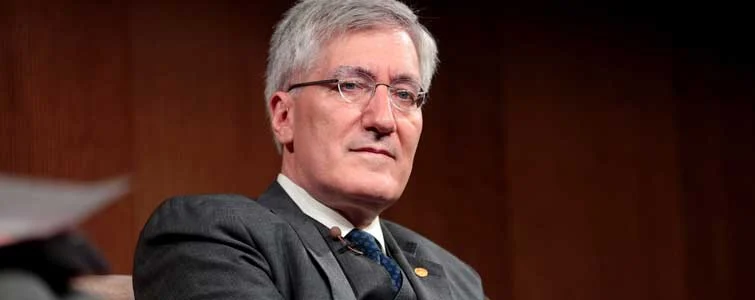
Fidelity Month was created by Robert P. George, the McCormick Professor of Jurisprudence at Princeton University and one of the most prominent conservative Catholic voices in American public life. George has long been associated with natural law philosophy and opposition to same-sex marriage, and has served as a guiding intellectual force behind organizations ranging from the Ethics and Public Policy Center to the American Principles Project.
George defines fidelity as “faithfulness — especially when it is challenging and unpopular,” and frames the initiative around four pillars: devotion to God, to spouses and families, to local communities, and to the country. Their website, fidelitymonth.com, says Americans have lost confidence in all four, and presents Fidelity Month as a corrective course, “lighting a candle rather than merely cursing the darkness.”
Now in its fourth year, the observance has grown from a modest online campaign into a coordinated movement with webinars, branded merchandise, an essay contest for students, a Washington, D.C. breakfast, and a national Day of Prayer and Fasting scheduled each June 24. Its imagery — a myrtle wreath, a symbol of classical fidelity, rendered in blue and gold — is intended to project tradition and virtue.
The Political Firepower Behind It
What has transformed Fidelity Month from an academic’s initiative into a political flashpoint is a roster of officials now formally lending it their offices and voices.
House Speaker Mike Johnson publicly endorsed the movement, calling George “a conservative Christian thought leader” and stating that his own family would observe Fidelity Month. Arkansas Gov. Sarah Huckabee Sanders made a formal gubernatorial declaration designating June as Fidelity Month in her state — a move widely covered as a pointed rebuke to Pride Month. And on Wednesday, Utah Gov. Spencer Cox quietly signed his own Fidelity Month declaration, a striking reversal for a governor who had previously been the first in Utah’s history to formally recognize Pride Month back in 2021.
Cox’s declaration was made without a public press release or social media announcement, but it did not stay quiet for long. LGBTQ advocacy groups Equality Utah and Project Rainbow Utah replied swiftly, saying the declaration suggested that queer Utahns lacked family values and patriotism, a characterization the group called both insulting and false. Utah Democratic lawmakers urged constituents to continue recognizing June as Pride Month, while noting the move comes amid a wider wave of anti-transgender legislation in the state.
The movement’s 2024 roundtable featured Kevin Roberts, president of the Heritage Foundation, and Ryan Anderson, president of the Ethics and Public Policy Center, two of the most influential institutions in forming conservative policy. Its 2026 kickoff includes Dr. Ben Carson of the American Cornerstone Institute and two Catholic archbishops, Salvatore Cordileone of San Francisco and Alexander Sample of Portland.
Fidelity Month’s organizers insist it is “multifaith and nonpartisan,” pointing to endorsements from Jewish and Muslim voices on their website. But the initiative’s deliberate occupation of June — the same month Pride has been observed nationally since 1999 — leaves LGBTQ advocates unconvinced of its neutrality.
For Utah’s LGBTQ community and those across the country, the convergence of state-level declarations, conservative think-tank support, and congressional endorsement signals that Fidelity Month is no longer simply a spiritual alternative to Pride. It has become a political instrument — and June, once the uncontested month of rainbow flags and hard-won visibility, is increasingly contested ground.