
Equality Utah’s 2026 endorsements spark backlash
Equality Utah, the state’s largest LGBTQ advocacy organization, released its 2026 election-cycle political endorsements this month, backing candidates across state legislative races, Salt Lake County government, and local school boards. The list reflects the organization’s long-standing “big tent” approach to politics in a deep-red state, but it has also reignited a familiar argument within the community it represents: Is bipartisan coalition-building protecting LGBTQ Utahns, or is it costing them ground?
The Slate
Equality Utah’s Political Action Committee endorsed 40 candidates this cycle, including:
Utah State Senate
CJ Hernandez (District 5), Jen Plumb (District 9), Emily Buss (District 11), Karen Kwan (District 12), Silvia Catten (District 13), Stephanie Pitcher (District 14).
Utah House of Representatives
Patrick Belmont (District 3), Angela Choberka (District 9), Rosemary Lesser (District 10), Stephen Otterstrom (District 21), Jen Dailey-Provost (District 22), Hoang Nguyen (District 23), Grant Miller (District 24), Angela Romero (District 25), Michael Finch (District 26), Anthony Loubet (District 27), Jake Fitisemanu (District 30), Verona Mauga (District 31), Sahara Hayes (District 32), Doug Owens (District 33), Julie Jackson (District 34), Blake Townsend (District 36), Ashlee Matthews (District 37), Chris McConnehey (District 38), Drew Howells (District 39), Andrew Stoddard (District 40), John Arthur (District 41), and Celeste Johnson (District 59).
Salt Lake County
Jiro Johnson (County Council, District 1), Mike Bird (County Council, District 3), Zach Robinson (County Council, At-Large), Lannie Chapman (County Clerk), Sim Gill (District Attorney), and Rosie Rivera (Sheriff).
School Boards: Andrew Edtl (Canyons District 4), F. Masita Taufahema (Jordan District), Zach Thomas (Ogden District 6), Oscar Mata (Ogden District 7), Ashley Anderson (Salt Lake City, Precinct 3), and, for the Utah State Board of Education, Nicole McDermott (District 8) and Sarah Reale (District 5).
At first glance, it’s a sprawling, largely Democratic-leaning list threaded with familiar LGBTQ-rights allies. But buried inside it are the choices that lit up Equality Utah’s social media accounts: several races where the PAC passed over an openly LGBTQ or trans-affiliated candidate in favor of a straight, and in some cases Republican, opponent — most notably the endorsements of Mike Bird over Luke Maynes in the County Council District 3 race and Republican incumbent Anthony Loubet over Democratic challenger Liz Oates.
The Backlash
The reaction arrived fast, loud, and public — stacking up in the comments beneath Equality Utah’s Instagram and Facebook posts announcing the slate.
Longtime supporter Jahn Curran didn’t mince words: “And you wonder why many of us have stopped donating and attending Equality Utah events. You are not listening to your constituency.” Curran argued the org’s reluctance to automatically back LGBTQ candidates over other qualified contenders wasn’t about protecting rights at all, but about “cozying up to the LDS Church and appearing ‘moderate’” — a strategy Curran said ignored the real damage a Republican supermajority does to queer Utahns.
Andy Dalrymple pushed back even harder on the premise of bipartisan balance itself, arguing that any “good Republicans” who might exist are swallowed by a party he described as increasingly authoritarian — and that “falsely equating both sides” wasn’t neutrality; it was surrender.

Frustration has also translated into action. Former candidate Evan Done pointed to a new alternative entirely — a PAC called Reflect Utah, created specifically to endorse and support LGBTQ candidates, seemingly in direct response to Equality Utah’s perceived inconsistency.
Other comments zeroed in on specific races the endorsement list didn’t include at all. Jess Wiarda flagged the Bird-over-Maynes decision as the one she found hardest to square with the org’s mission. Lindsey Skinner raised the case of David Chappell, an openly queer candidate with a long organizing history running a competitive campaign in Provo’s House District 62 — a race Equality Utah declined to weigh in on. And Anne Berbert offered one of the most personal accounts: three Davis County candidates, each parenting a transgender child, who had shown up to committee hearings and legislative meetings to advocate for kids largely ignored by the supermajority — only to be passed over for endorsement, with one candidate’s application never even receiving a confirmation email. “I was grieved not to see him endorsed,” she wrote, describing a colleague whose trans son was hospitalized this year.
A group of Democratic leaders, many of whom are on the endorsement list, published a statement against the PAC’s decisions.
“Equality Utah has a long history we respect, which is exactly why this cycle’s endorsements are so disappointing,” the statement began. “There were talented, openly queer candidates on the ballot this year, running real, competitive campaigns, and in multiple races Equality Utah either declined to endorse them or endorsed their opponents instead. That’s not a small oversight. It’s a departure from what this organization is supposed to stand for.”
“Queer representation in Utah politics doesn’t happen by accident. It happens when organizations like Equality Utah use their influence to back candidates who reflect their community, especially when those candidates have a real shot at winning. When that support isn’t there, it sends a discouraging message to every queer Utahn thinking about running for office,” the statement continued.
Mike Bird/Luke Maynes race
The largest pushback was on EU’s decision to endorse Republican Mike Bird over out Democrat Luke Maynes.
This was Bird’s second endorsement from Equality Utah. The first came when he ran for a Utah House seat, which he didn’t win. He said he was “humbled” and “honored to be able to be trusted with [Equality Utah’s] support.”
“I think that’s one of the things that I have really appreciated about Equality Utah is that they are always wanting to collaborate, work hard to make our community better, and to be able to not focus too much on partisan areas of that process,” he told ABC 4 News. He also said his support for the LGBTQ+ community is personal: “My twin brother just celebrated his second year and second anniversary with his husband.”
Maynes was endorsed by the national LGBTQ+ Victory Fund, which says Maynes will be the “first out trans/non-binary person on the County Council” if elected.
Maynes said his interactions with Equality Utah were positive and that they are grateful for their work.
“If they want to endorse a longtime supporter over a queer candidate, that is their prerogative,” they said. “And if elected officials take issue with their process, then that is their prerogative as well.”
Anthony Loubet/Liz Oates race
Many commenters were angry that the PAC endorsed Republican Rep. Anthony Loubet over Democrat Liz Oates.
Loubet has a mixed voting record on LGBTQ+ and transgender issues. In 2024, he was one of only three House Republicans who broke ranks to vote against HB257, which restricted transgender access to bathrooms and changing facilities in publicly owned buildings. In a statement about his “no” vote, Loubet said he had “unresolved concerns and questions” and wanted to ensure the legislation did not negatively impact his district on the west side of the Salt Lake Valley.
Conversely, Loubet voted in favor of a 2025 law that required transgender students at public universities to be assigned to dormitories based on their sex assigned at birth. In 2026, he voted for HB174, which, in part, forbade doctors from continuing hormone therapy for minors, even if they had already started the treatment
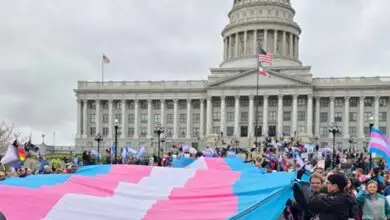
Oates is a staunch advocate for transgender rights, especially among trans youth. She is a mother of a trans teen and attended the rally where the Utah Pride Center unveiled the largest trans flag in the world with them.
On her campaign website, she writes, “The continued culture wars and political attacks on marginalized communities and underrepresented individuals do not make our state better, safer, or more affordable. Liz believes all residents should be uplifted and supported fairly and equally, not attacked to advance partisan political agendas.”
The Organization’s Response
Facing the wave of criticism, Equality Utah PAC’s Max Green issued a statement defending both the process and the outcome. Green acknowledged the disappointment directly and affirmed that “LGBTQ representation in public office matters” and that openly LGBTQ candidates “deserve recognition and respect” for the unique challenges they face in running.
But he drew a clear line: “LGBTQ identity alone does not determine an endorsement from the Equality Utah Political Action Committee.” Endorsements, he explained, are decided by an independent Board of Directors weighing five factors — a candidate’s commitment to the LGBTQ community, their ability to build bridges and govern, campaign viability, the potential impact of an endorsement, and the strategic opportunities in each race — applied “consistently… regardless of political party, sexual orientation, gender identity, or personal relationship with our organization.”
That framework, Green said, means the PAC will sometimes back Republicans over Democrats, sometimes decline to endorse in races where both candidates support the community, and — as happened this cycle — sometimes endorse a candidate running against someone who is themselves LGBTQ. “Those decisions are never a judgment about whether someone belongs in our movement,” he wrote, “or whether their voice deserves to be heard.”
Green closed by reaffirming the organization’s 25-year identity as a coalition-builder that spans “any one political party, ideology, geography, or identity,” and by leaving the door open: “An endorsement decision in one election does not close the door on partnership tomorrow.”
The Underlying Tension
What’s playing out in Equality Utah’s comment sections is really a fight over political theory, not just individual races. The organization’s model — bipartisan bridge-building in a state where Republicans hold a legislative supermajority — has historically been credited with hard-won wins even under one-party rule. Critics now argue that model has calcified into caution, at a moment when bills like Utah’s flag ban suggest the supermajority itself, not the goodwill of individual legislators, is the actual obstacle.
Whether that translates into real fallout like the loss of donors or a rival PAC gaining traction will likely become clearer as Utah’s 2026 election season moves forward. For now, Equality Utah stands behind its slate, and a visible slice of its base stands in open disagreement.