
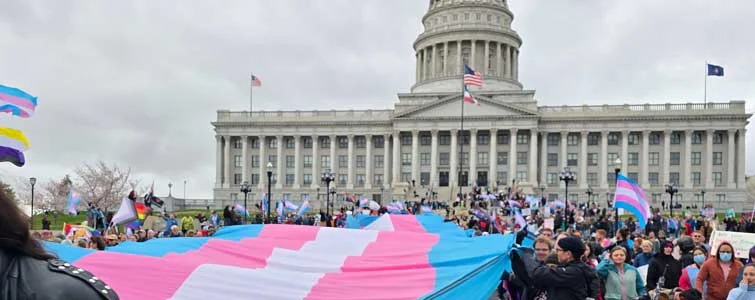
As November begins, Utah’s transgender community and its allies are marking Transgender Awareness Month. The month builds toward Transgender Awareness Week, Nov. 13–19, and the Transgender Day of Remembrance on Nov. 20.
This year’s observance follows what advocates describe as the fifth straight legislative session in which Utah lawmakers took up multiple bills aimed at transgender residents. Community groups have responded with visibility campaigns, support networks, and another round of public storytelling.
Utah’s Republican-led Legislature has built up a body of law on transgender issues since 2022. That year lawmakers banned transgender girls from competing in girls’ school sports, overriding Gov. Spencer Cox’s veto. In 2023, they restricted gender-affirming medical care for minors. A 2024 law, HB 257, set restroom and locker room rules in public schools and government buildings based on sex at birth. Lawmakers have also required public colleges to assign dorms by sex at birth.
The 2026 session added to that record. Rep. Rex Shipp and Sen. Dan McCay sponsored HB 174, which was signed by the governor on March 18 and took effect May 6. Under the final version, minors 16 and older who were already receiving hormone therapy may continue. All other minors must stop by Jan. 28, 2027, according to the ACLU of Utah, which had urged Cox to veto the bill.
Supporters say the limits protect young people from irreversible medical decisions.
“Kids shouldn’t be taking hormone blockers, puberty blockers,” House Speaker Mike Schultz, R-Hooper, said in January. Opponents point to a state-commissioned review of studies on youth gender-affirming treatment that linked the treatments to positive effects on mental health and well-being.
Lawmakers also passed HB 404, signed March 23. It amends the Utah Fair Housing Act to let landlords designate housing as single-sex based on biological sex. It says such restrictions are not unlawful discrimination. Advocates, including the Utah Housing Coalition, warned it could collide with federal fair housing law and make housing harder to find for a group already facing instability.
Not every proposal succeeded. HB 193, which would have barred public funding for gender-affirming care, stalled in a Senate committee. Some Republican lawmakers said it could cost taxpayers more and infringe on adults’ medical decisions. HB 183 began as a sweeping measure that would have stripped gender identity protections from the state’s hate crimes law, among other changes. It was pared back and did not become law. A separate 2026 bill to further limit the flags cities can fly also failed.
The federal backdrop looms as well. The U.S. Supreme Court upheld Tennessee’s ban on gender-affirming care for minors. Equality Utah told transgender Utahns at the start of the session that federal executive orders were shaping the debate at the Capitol.
Utah’s laws don’t apply in every setting. The ACLU of Utah notes that HB 257’s restroom rules apply mainly to public schools and government buildings, not to restaurants or hotels. Utah’s nondiscrimination law, passed in 2015, remains on the books.

The organizations holding the community together
Utah’s transgender-focused work runs through a handful of groups, some long-standing and some newer. Transgender Education Advocates of Utah, a trans-led nonprofit founded in 2003, was a fixture of that work for nearly two decades before it ended its activity in 2022.
The Utah Pride Center hosts a free Transgender and Non-Binary Support Group at its downtown Salt Lake City location. Therapists from Arches Healing & Growth facilitate it, and no registration is required. With the Glitter Foundation, the center also co-hosts the annual Transgender Day of Visibility rally and march at the Capitol. This year’s was March 29 and featured the country’s largest transgender flag.
The Glitter Foundation, a Salt Lake City nonprofit, runs the Transgender Memorial Flag Display and the Transgender Day of Remembrance, which honor people lost to anti-trans violence. This year, the display debuted at the Utah Pride Festival. It was also shown at WorldPride 2025, where 400 flags told individual stories. The foundation co-hosts an annual sober trans pool party for adults with the Pride Center and UAF Legacy Health.
Project Rainbow Utah, founded in 2018, runs a Trans Awareness Flag Campaign each November. This year’s campaign runs Nov. 9–21. Participants can reserve a one-time flag, either staked in their yard in select northern Utah service areas or mailed anywhere in the state. Year-round subscribers receive flags for Trans Awareness Week, Trans Day of Visibility, and Pride Month. Proceeds support the group’s Community Fund grants. Project Rainbow also participated in last year’s Sego Visibility Flag raising in Salt Lake City alongside the Utah Trans+ Coalition.
Equality Utah and the ACLU of Utah carry much of the legislative fight, tracking bills, testifying, and mobilizing supporters.
Faces of the movement
Behind the bill numbers are people who spend their winters in committee rooms and their autumns planning vigils.
Dallas Rivas runs the Glitter Foundation and is a central organizer of Transgender Day of Remembrance in Utah. Each year he collects the names of transgender people killed around the world and builds them into the Transgender Memorial Flag Display. Each flag carries a name. At a 2021 vigil outside the Salt Lake City and County Building where Rivas spoke, 427 flags stood for the people lost that year. Rivas has described the project as emotional work, noting that many victims were never recognized in life. The display moved last year to the plaza of St. Mark’s Episcopal Cathedral after eight years at the City and County Building. This year it also reached a new audience at Utah Pride.
Jack Adams, who is transgender and uses they/them pronouns, began advocating at the Capitol in 2019. They describe that year as the start of a string of attacks on transgender rights. Adams is part of the newly formed QT Care Team. The group showed up this session with hugs, snacks, and a banner reading “You can’t legislate us out of existence.” Team members greeted people leaving committee hearings, some in tears, and handed out trail mix and jerky from a box with a hand-drawn heart. “Doing care work for each other is the only way we make it through,” Adams said. Adams also criticized lawmakers for continuing to host a “public debate at the state Capitol over whether or not trans people exist.”
Kree Arias, a trans man from Salt Lake City, is a model, drag performer and promoter who works with the Utah March organization. He was among more than 60 people who marched to the Capitol on Jan. 21 against the session’s anti-transgender bills, an event organized by Veronika DaVil. Arias told reporters the community intends to remain visible. After a House committee limited public comment on HB 183 to 30 seconds per person, he said he was exhausted from trying to reach lawmakers. “We just ask that you respect us as human beings,” Arias said. “We deserve the same rights as everybody else.”
Brynn Mikesell testified before a House committee against HB 183, a bill that some transgender Utahns said would allow their identities to be erased. Mikesell told lawmakers the transgender community poses no threat. “This is my community, and we are not a threat to you,” Miksell said. “We just want to live our lives.”

Alex del Rosario, the national organizer for Advocates for Trans Equality, one of the country’s few national trans organizations, lives in Salt Lake City. A Filipino immigrant who began organizing in 2016, Del Rosario moved from Washington state to southern Utah in 2017, less than a day after graduating from college. He has said Utah is where he found his community and stepped into his transness with pride. At the Nov. 13, 2024, trans flag raising at the Salt Lake City and County Building, Del Rosario urged people to share their stories and look after one another. “Finding trans and queer community in Utah helped me become more myself,” he said.
November 2026
Salt Lake City’s observances have followed a pattern in recent years. Awareness Week opens with a flag raising. Last year, on Nov. 13, the city raised the Sego Visibility Flag for the first time. The flag was created to represent the city’s transgender community. Lawmakers restricted “unofficial” flags in government spaces in 2025.
The Glitter Foundation’s plans for Transgender Day of Remembrance are taking shape. Rivas said the group is deciding between two venues and expects to announce the location soon. Volunteers will set up the Transgender Memorial Flag Display on Saturday, Nov. 14, which is expected to stay up for about two weeks. A remembrance service is planned for Friday, Nov. 20, followed by a candlelight vigil. The vigil’s location is pending the venue decision.
Rivas is still compiling this year’s annual list of names, which he said is very large and may be the biggest so far. The names on that list become the flags in the display.
Anyone with questions, or who wants to volunteer, can call Rivas at 801-604-7062.
Organizers say the point of the month is twofold: to honor those lost to violence, and to make transgender Utahns visible as neighbors, coworkers and family members. Those seeking help year-round can reach the Utah Pride Center at 801-539-8800. They can also call or text 988 for the Suicide & Crisis Lifeline. Q
Watch qsaltlake.com for more details as they are announced throughout the month.